What Is a Voodoo Doll and Can You Connect to One

A small cloth figure with pins in it is one of the most misunderstood images in modern spirituality. For many people, the phrase “voodoo doll” brings up horror movies, revenge scenes, curses, and fear. That image says more about popular culture than it does about Haitian Vodou or the many spiritual traditions that use symbolic objects.
A better question is not “Are voodoo dolls real?” It is: what do people mean when they say voodoo doll, and what role can a doll, figure, or effigy play in spiritual practice?
The answer takes care, because several traditions often get mixed together in movies and online discussions. Haitian Vodou, Louisiana Voodoo, Hoodoo, European folk magic, ceremonial magic, and pop culture are not the same thing. Some may use dolls, figures, packets, charms, or symbolic objects in certain contexts. Others may not. Even within one tradition, practice can vary by lineage, teacher, community, and purpose.
What people usually mean by a voodoo doll
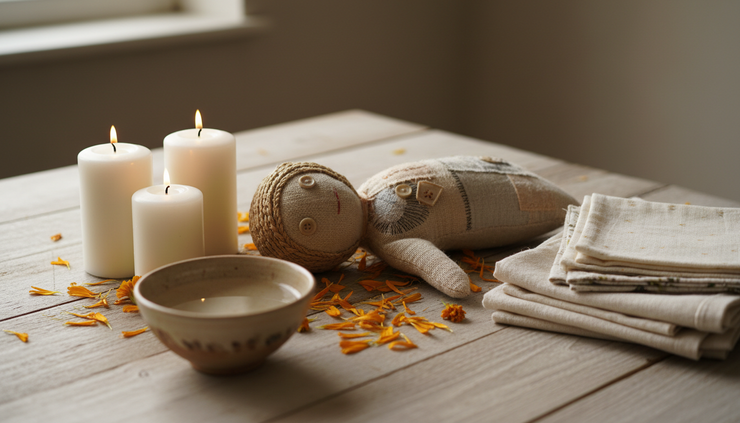
When people say “voodoo doll,” they usually mean a doll or small human-shaped figure believed to represent a person. In popular imagination, someone names the doll, attaches a photo or personal item, then uses it to influence the person it represents.
That idea is not limited to Vodou. Human-shaped figures appear in many spiritual and magical systems across history. They may be made from cloth, wax, clay, wood, corn husks, paper, roots, or other materials. Some represent a living person. Others represent an ancestor, a spirit, a prayer, an illness, a wish, or a part of the self.
The phrase itself can be misleading. Dolls and effigies are not a universal or defining practice of Haitian Vodou. Haitian Vodou is a rich Afro-Caribbean religion with its own theology, rituals, songs, spirits, ethics, priesthoods, ceremonies, and community obligations. Reducing it to dolls and pins distorts the tradition.
The “voodoo doll” image many people recognize developed through a mix of colonial fear, racist caricature, sensational journalism, stage magic, horror films, and tourism. It often turns African diasporic religion into something spooky or dangerous for entertainment. A respectful discussion has to separate that stereotype from actual living traditions.
Haitian Vodou, Louisiana Voodoo, Hoodoo, and pop culture are not interchangeable
These terms often get used as if they mean the same thing. They do not.
Tradition or category | What it generally refers to |
Haitian Vodou | An Afro-Caribbean religion that developed in Haiti from West and Central African religions, Catholic influences, Indigenous context, and Haitian history. It involves devotion to Bondye, service to the lwa, ceremony, song, dance, offerings, healing, and community life. |
Louisiana Voodoo | A related but distinct tradition shaped in Louisiana, especially New Orleans, through African diasporic spirituality, Catholicism, local culture, and historical figures such as Marie Laveau. It has its own regional expressions. |
Hoodoo | An African American folk spiritual practice, also called conjure or rootwork by many practitioners. It is not the same as Vodou. It often includes biblical prayer, herbs, roots, candles, charms, personal concerns, and practical spiritual work. |
Popular culture “voodoo” | A fictionalized image found in films, TV, Halloween décor, and tourist objects. It often blends unrelated practices and exaggerates harm, fear, and control. |
These categories can overlap in history, geography, and influence, but they should not be treated as identical. A Haitian Vodou ceremony is not the same as a Hoodoo honey jar. A New Orleans souvenir doll is not the same as a consecrated religious object. A horror movie curse scene is not a reliable source on any tradition.
The most respectful approach is to name the tradition being discussed, learn from qualified sources within that tradition, and avoid using “voodoo” as a catchall word for any kind of magic.

Why dolls and figures appear in spiritual practice
Human beings use symbolic objects because symbols help the mind, heart, and spirit focus. A wedding ring is not the marriage itself, but it can carry the meaning of commitment. A photograph is not the person, but it can stir memory and emotion. A prayer candle is not the prayer, but it can help someone hold attention.
Dolls, figures, and effigies can work in a similar symbolic way.
Across different cultures, figures have been used for many purposes:
To represent a person during prayer or ritual
To carry a request for healing, protection, or blessing
To act as a focus for grief, release, or transformation
To symbolize an illness, habit, fear, or emotional burden
To honor ancestors, spirits, saints, or sacred forces
To teach stories, values, or spiritual lessons
Some figures are made to resemble a person. Others are intentionally simple. Some are named. Some are dressed in certain colors. Some contain herbs, written prayers, petitions, stones, personal items, or other materials. In some traditions, these materials are chosen because they correspond to a goal, spirit, planet, saint, element, or spiritual quality.
This does not mean every doll is magical. A doll can be art, memory, comfort, craft, devotion, ritual tool, or ordinary decoration. Meaning comes from context, intention, tradition, and any ritual process used to prepare it.
Can I connect to a doll
The short answer is yes, some people believe they can form a symbolic or spiritual connection with a doll or figure. The longer answer is that traditions explain that connection in different ways.
A practitioner might understand connection through representation. The doll stands in for a person, a goal, an emotion, or an aspect of the self. In this view, the figure works like a spiritual focal point. It gives the prayer or intention a place to land.
Another practitioner might understand connection through personal concerns. In some folk magic traditions, items linked to a person can strengthen the symbolic tie. These may include a name written on paper, a photograph, handwriting, a piece of clothing, hair, nail clippings, or something the person touched. Not every tradition uses these things, and not every practitioner agrees on what is proper.
Connection can also happen through naming and attention. A name can carry identity. Speaking a name in prayer, writing it on a petition, or placing it near a candle may help focus the work. A photograph can do the same. For some people, a doll connected to self-love or healing may represent their own inner child, body, courage, or future self.
Some traditions also involve ritual preparation. That might include prayers, cleansing, blessing, dressing with oils, placing the figure on an altar, making offerings, or working with a spiritual elder. In closed or initiatory traditions, certain steps may only be appropriate for trained practitioners or initiated members.
The key point is simple: beliefs and practices vary. A doll is not automatically spiritually connected to anyone just because someone says it is. Connection depends on the worldview, method, consent ethics, and spiritual authority of the tradition being practiced.

Positive ways a meaningful doll or figure may be used
Many discussions about dolls focus on harm, but spiritual figures can also support constructive work. In traditions that allow this kind of practice, a doll or figure may be used as a focus for care, healing prayer, personal growth, and protection.
Protection
A protective figure may symbolize safety around a person, home, child, or vulnerable part of the self. It might be placed in a respectful location, prayed over, dressed in protective colors, or paired with protective herbs or symbols, depending on the tradition.
This kind of work is usually about strengthening boundaries, asking for spiritual covering, or reminding the person to act with wisdom.
Healing intentions
Some practitioners use dolls as a focus for healing prayer. The figure may represent the person receiving care, or it may represent the condition being prayed over. This should not replace medical care. Spiritual practice can be meaningful to people while still respecting doctors, therapists, medicine, and practical support.
A healing figure might be held during prayer, placed near a candle, or surrounded with symbols of peace and restoration.
Self-love and emotional strengthening
A doll can represent the self in a gentle and compassionate way. Someone might create a figure to support self-forgiveness, confidence, body acceptance, emotional resilience, or inner child work.
For example, a person might speak kind words over the figure, dress it in colors that feel comforting, or place it somewhere visible as a reminder of care. The power of that practice may be spiritual, psychological, devotional, or all of these at once, depending on the person’s beliefs.
Confidence and personal transformation
A figure can also mark a transition. It may represent the version of a person who is becoming braver, clearer, calmer, or more grounded. This can be part of prayer, journaling, candle work, meditation, or ancestral devotion.
The point is not to force reality to obey an object. The figure helps focus intention, emotion, and spiritual attention on change.
Prayer or focused intention
For many people, the most meaningful use is simple prayer. The doll becomes a reminder to keep praying, keep healing, keep working, or keep trusting. In that sense, it functions much like a rosary, prayer card, written petition, candle, or sacred image.
What movies get wrong about pins and harm
The most common movie image is simple: someone sticks a pin into a doll, and another person immediately feels pain in the same place. That scene is dramatic, easy to film, and memorable. It is not a fair description of Haitian Vodou, and it is not a universal law of magic.
Pins, when used in folk practices, do not always mean harm. In some traditions or modern magical systems, pins may be used to fasten something in place, focus attention, mark a point, hold a petition, direct energy, or symbolically “pin down” a problem. Context matters.
That said, some historical practices involving effigies have been connected to coercion, hostility, binding, revenge, or cursing. Those topics exist in the history of magic and religion, just as protective and healing practices do. A respectful educational discussion can acknowledge that without giving instructions for harm.
Ethically, many practitioners avoid work meant to violate another person’s will or cause suffering. Others follow the rules of their specific tradition, teacher, spirits, or community. People who practice any form of spiritual work should take questions of consent, responsibility, and consequence seriously.
A doll does not automatically give someone remote control over another person’s body. Real spiritual traditions are more complex than that, and human beings are not props.
Why cultural respect matters
Curiosity is natural. Many people first hear about dolls through entertainment, then later discover deeper spiritual questions. Curiosity becomes respectful when it includes patience, context, and humility.
That means not pulling random pieces from Haitian Vodou, Hoodoo, Catholic folk devotion, witchcraft, and internet spell lists into one mixed practice without understanding where they come from. Some traditions are open. Some are closed. Some require initiation, elders, lineage, or community. Some practices belong to specific histories of survival, oppression, migration, and sacred obligation.
Respect can look like this:
Learning the correct names for traditions
Reading or listening to practitioners from those communities
Avoiding stereotypes about “dark” or “evil” religions
Not treating sacred objects as spooky décor
Asking whether a practice is yours to use
Choosing simple prayer, meditation, or personal symbolism when unsure
If a doll or figure feels meaningful, it does not have to be labeled “Vodou” to matter. A person can create a symbolic self-love figure, remembrance doll, healing token, or prayer object without claiming a tradition they do not belong to.

A grounded way to think about spiritual dolls
A spiritually meaningful doll is best understood as a symbolic vessel. It may hold prayer, memory, intention, identity, or devotion. In some traditions, it may also hold a deeper spiritual link created through ritual. In others, that idea may be rejected completely.
So, can you connect to one? Within some belief systems, yes. That connection might come through intention, naming, prayer, personal items, photographs, ritual preparation, or emotional focus. But the meaning of that connection depends on the tradition, the practitioner, and the ethics behind the work.
The most respectful path is to slow down. Learn what tradition you are working within. Do not assume that a horror-movie image reflects Haitian Vodou or any living spiritual practice. If you feel drawn to a doll or figure, ask what you want it to represent: protection, healing, self-love, confidence, emotional strength, transformation, or prayer.
A doll does not need fear to be powerful. Sometimes its deepest meaning is care, focus, and the human need to give invisible hopes a visible form.


Comments